Fleet operations · Operator preview

Catch the surprise before it reaches the ramp.

Liito connects the trip, the aircraft, the schedule, and the money, so you catch what's coming while you can still fix it: a flight held when a medical or inspection lapses, a maintenance-deferral (MEL) clock caught before you sell the trip, a double-booked rental flagged before it happens, and the hours billed before they slip away.

Charter Training Rental Owner-flown
Projectedevery check runs for the day it flies
Citedevery result tied to the rule behind it
One recordaircraft, people, and money together
lii·to\ˈlē-tō\noun · Finnish
gliding flight.
Smooth flight, smooth operations.
Who it's for

Built for the operator who runs more than one kind of operation.

If your business is a single neat line, you have simpler options. Liito is for the operators whose week doesn't fit in one, and whose airplanes, people, and compliance are scattered across a stack of tools that have never talked to each other.

Different missions, one operation. That's the operator Liito was built for, and the reason it's one system, not four.

See it all

Your operation handles it all. So does Liito.

Charter, a flight school, leaseback aircraft, an owner who flies their own jet. You keep it all straight across a stack of tools, spreadsheets, and sticky notes, and you make it work. Liito runs the whole operation on one set of records: the same airplanes, the same people, the same airworthiness picture. So you're not keeping the same facts in six places by hand.

Commercial charter

Part 135

Your bread and butter, and the strictest flying you do. Every leg clears the §135 gate before it goes, and the invoice settles on the hours you actually flew.

The strictest checks · billed to the customer

Flight training

Part 61 / 141

Your own pilots' currency and your customers' lessons, in one place. A sign-off counts only when the training actually met the requirement, not just because the airplane flew.

Instructor signs off · currency only when earned

Rental

Part 91

A rental hour is just another hour. Renter-flown or company-flown, it lands on the same meters and moves the next inspection like a revenue leg does.

Billed by usage · the hours drive maintenance

Owner-flown

Part 91

The airplanes you manage for owners, held to the same gate and records as the fleet you fly for hire. They run on the Part 91 ruleset, so none of the §135 duty, rest, or FRAT requirements apply.

Held to your fleet's standard · billed to the owner or run in-house

One model of aircraft, maintenance, people, and money. And one release gate that knows which rules each flight flies under. Liito runs multiple interlocking checks on every leg, the kind that are difficult to calculate by hand, and only the checks that apply to that operation type. Switch missions, not systems.

Take the tour

Four surprises caught early, then the next trip.

This is the walkthrough we run in a demo. Start on the dashboard, open up why each flight is held, and finish by planning the next trip with the same checks in place.

1

Read the day Operations Dashboard

The day opens with what needs action and why: what is held for release, what needs information, what is waiting on a customer, what is flying today. Each row states its blocker in plain words, next to the one button that starts the fix.
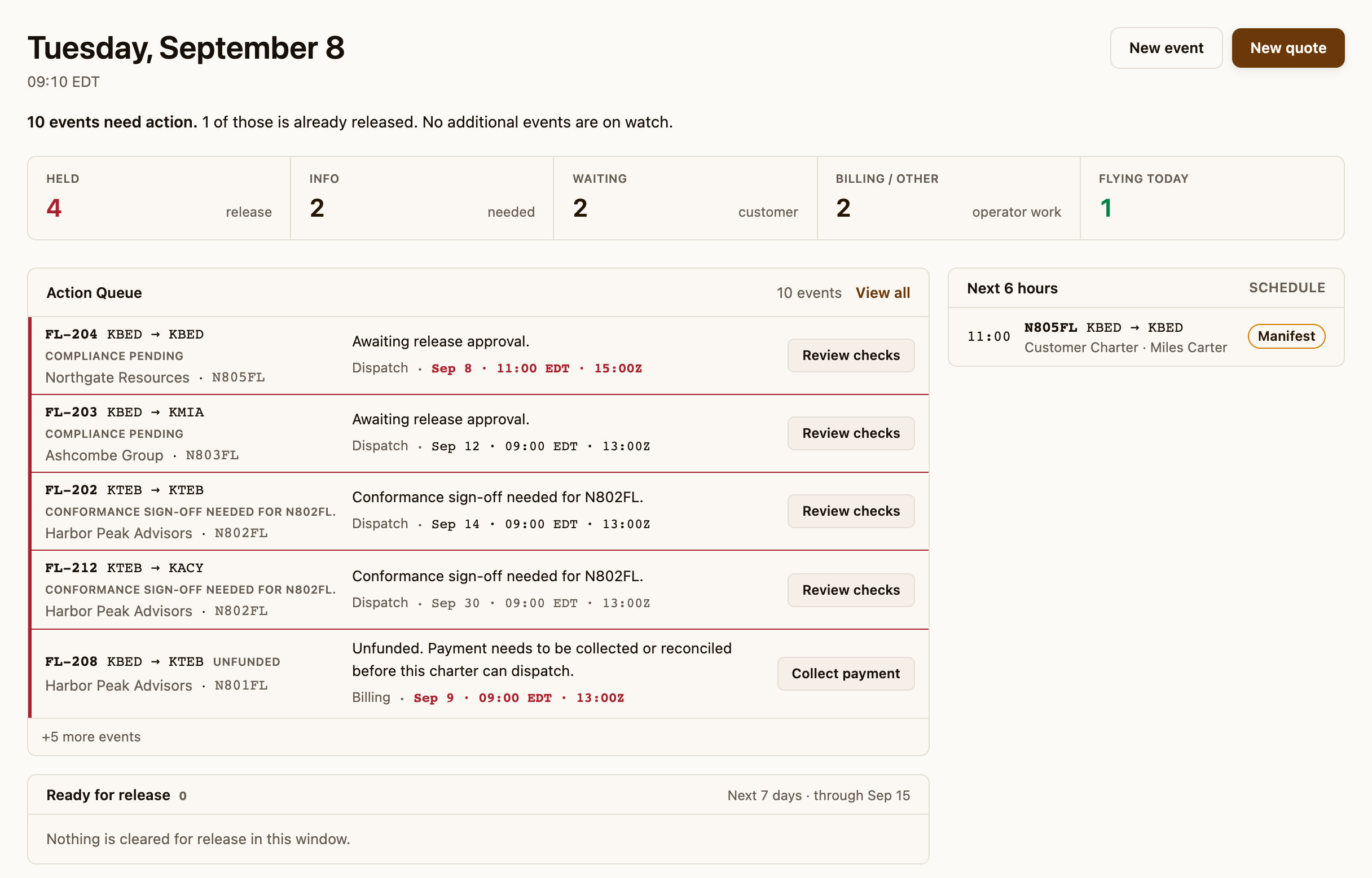
The Liito dashboard for an operating day: counts for held, information needed, waiting on customer, billing, and flying today, and an action queue where each event states its blocker in plain words next to one button.
The operating day: held, needing information, waiting on a customer, flying.
2

Hold release until it checks out Trip lifecycle

Open the trip and the fuzzy "are we good to go?" gets a concrete answer. The whole trip sits on one face: what, who, when and where; aircraft and crew; the commercial state; progress to release; review. The next action names the blocker in plain words, here an inspection projected to be overdue at arrival, and the leg wears its own status.
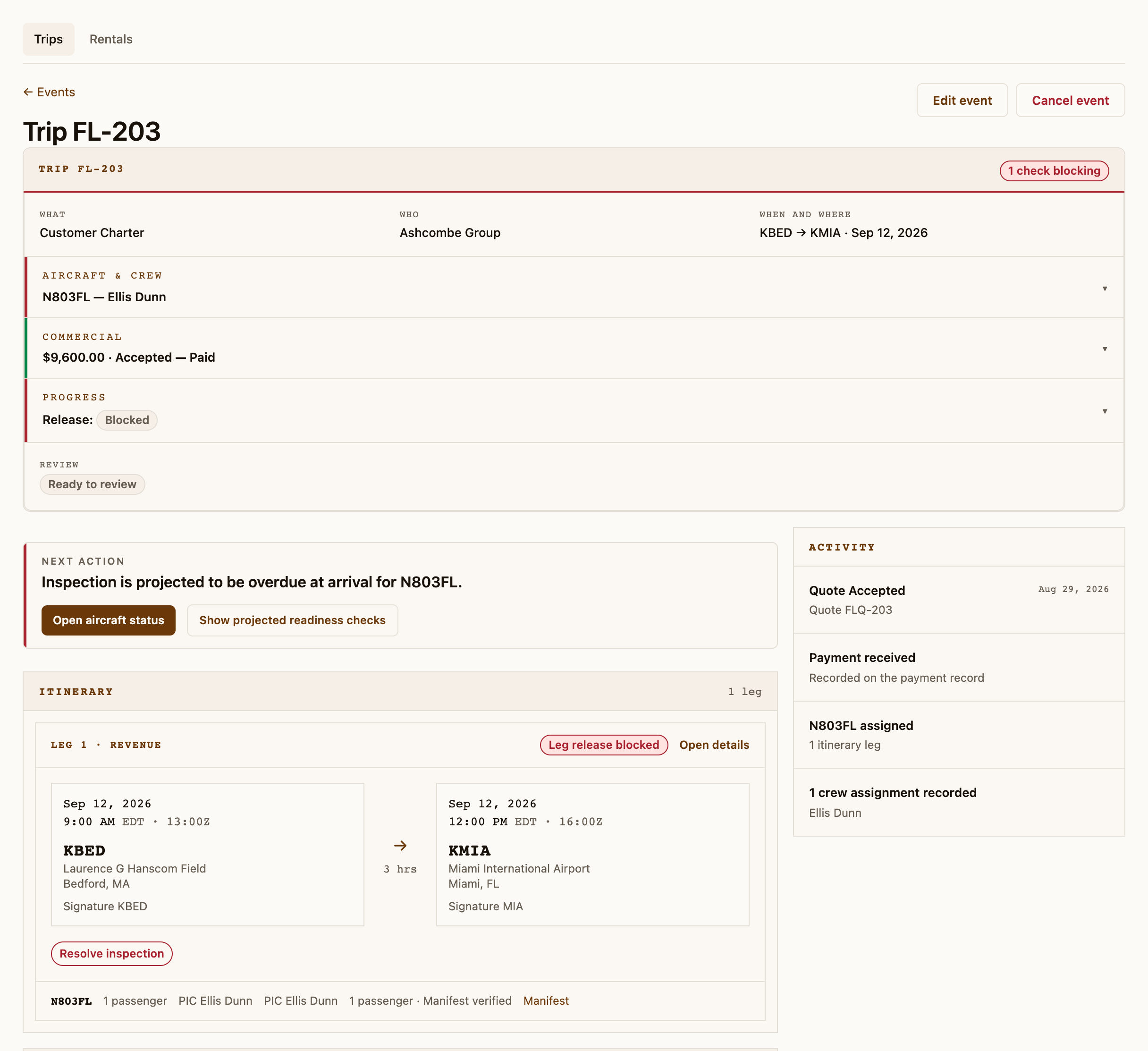
A customer charter in Liito, accepted and paid, with release blocked: the next action reads that the inspection is projected to be overdue at arrival for the assigned aircraft, with buttons to open the aircraft status or the projected readiness checks, and the itinerary leg marked release blocked.
A charter four days out, accepted and paid, held: the face says why, and what to do next.
3

Catch a double-booking before it happens Operations calendar

One calendar carries trips, crew, maintenance, training, and rentals together. Liito shows which trip or rental owns the conflict and what to check next. It does not pretend to have made the call for you.
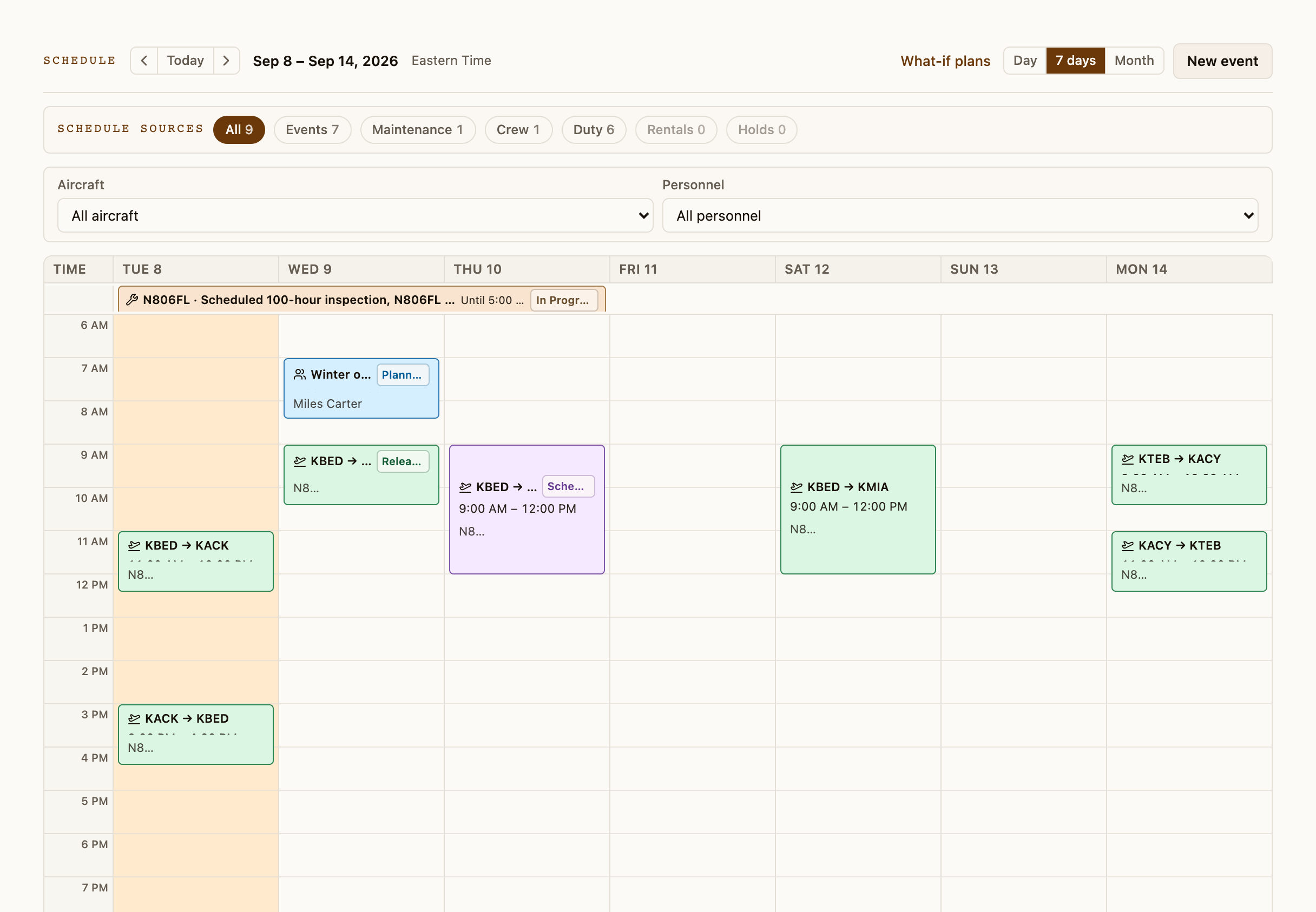
The Liito schedule for one week with every source on it: events, maintenance, crew, duty, rentals, and holds, each block wearing its type and status.
One week, every source: events, maintenance, crew, duty, rentals, holds.
4

Catch the inspection before it comes due mid-trip Aircraft detail

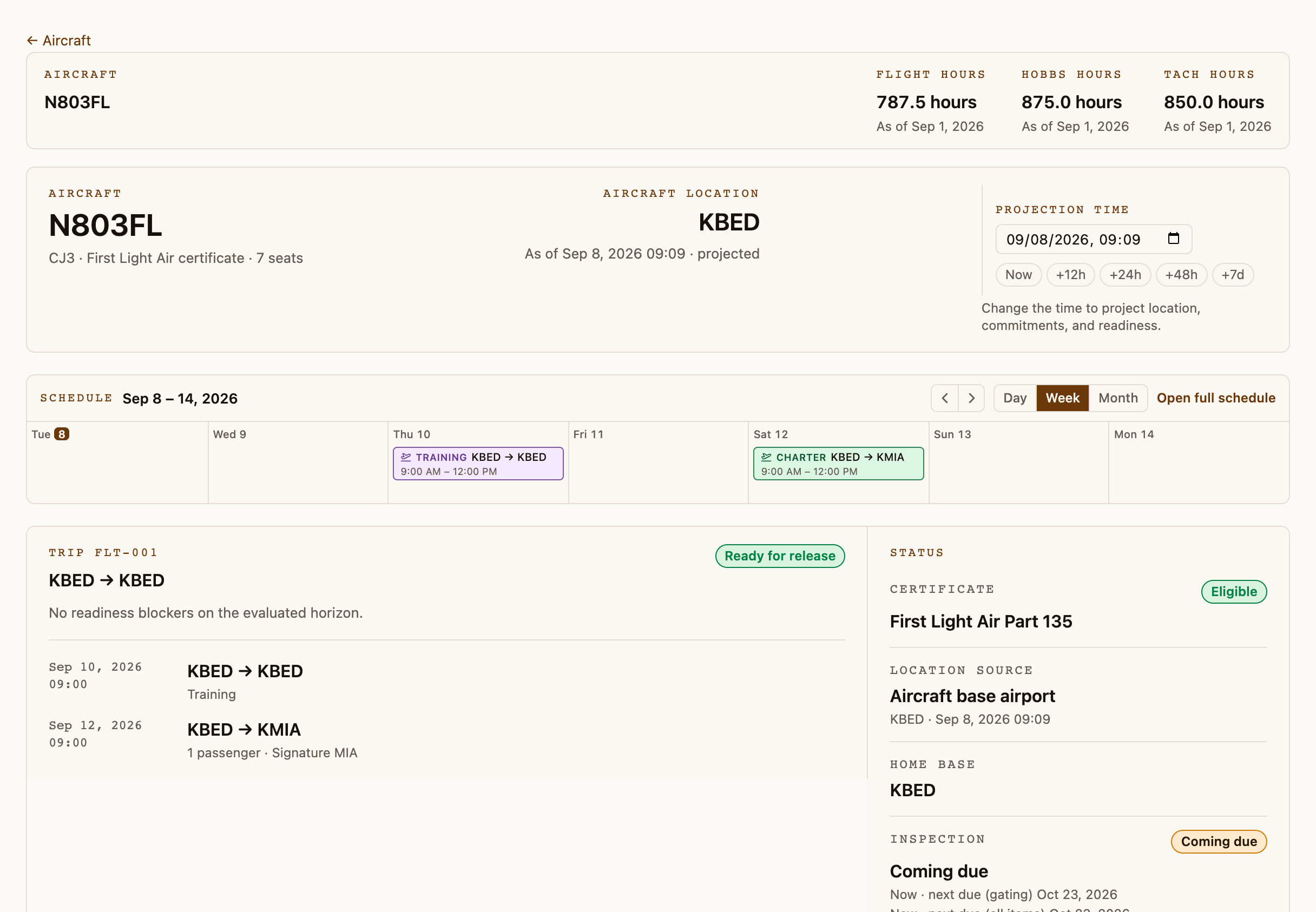
Every airplane has its own page, and the page answers for any moment: move the clock and the location, commitments, and readiness re-answer for that time, while today's actual numbers stay put. Open the inspection projection and it adds up what is already on the schedule: 787.5 hours now, a training flight before this trip, then this leg, 793.5 projected at departure against a 100-hour limit of 792.5. One hour over, caught four days out, with the ways out listed.
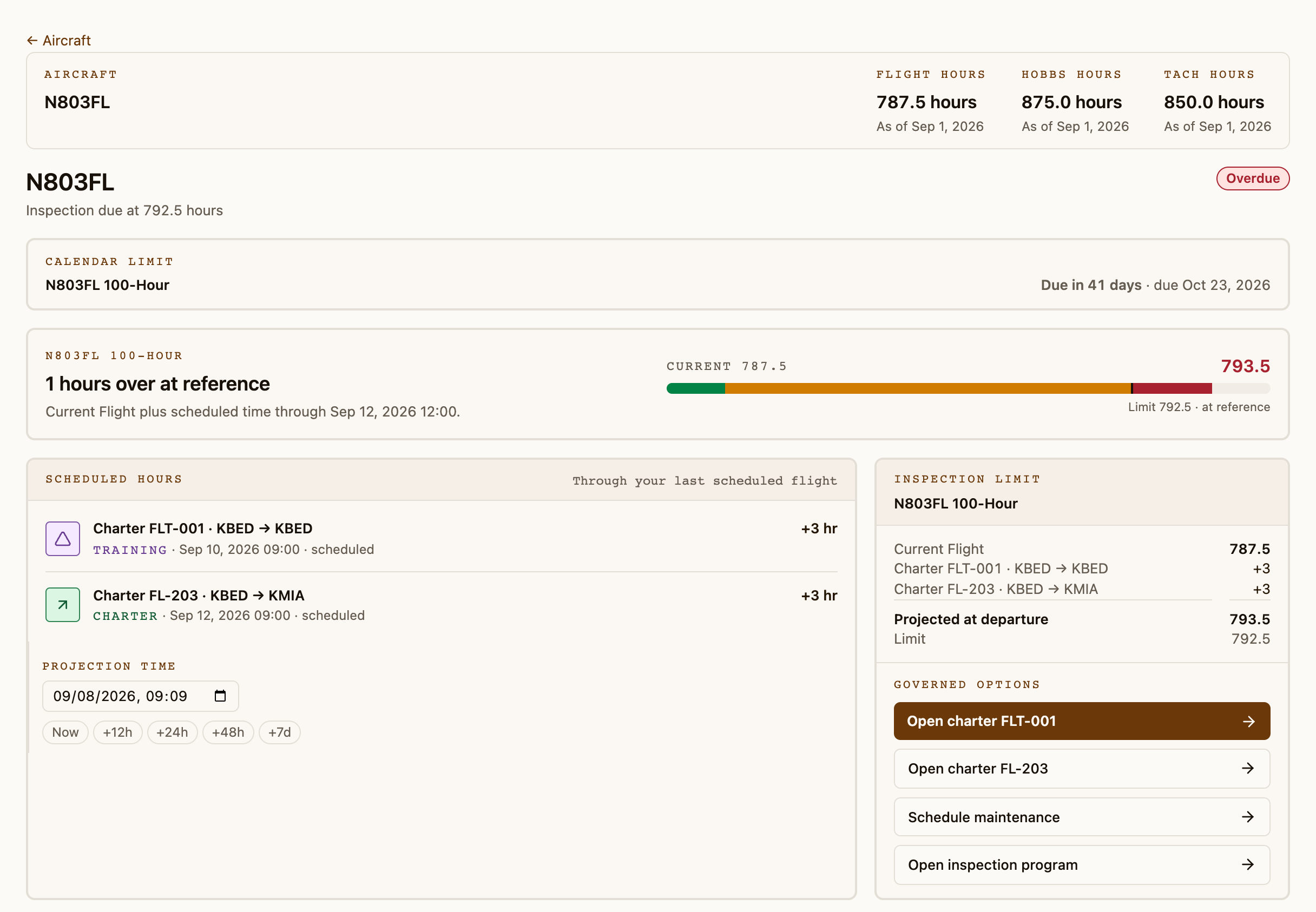
The inspection projection page for one aircraft: the 100-hour limit at 792.5 hours, current 787.5, the scheduled training flight and charter each adding three hours, 793.5 projected at departure, marked overdue, with the options to open either flight, schedule maintenance, or open the inspection program.
One airplane's inspection clock, projected through everything scheduled before the trip. The arithmetic is shown, and so are the ways out.
5

Plan the next trip New activity

After the surprises, start the next piece of work by naming what it is: a charter quote, a charter that skips the quote, a positioning or ferry leg, a rental, an owner-use flight, ground maintenance, or a maintenance check flight. Each choice opens its own planning flow, and they all land on the same schedule underneath, so the checks are already waiting.
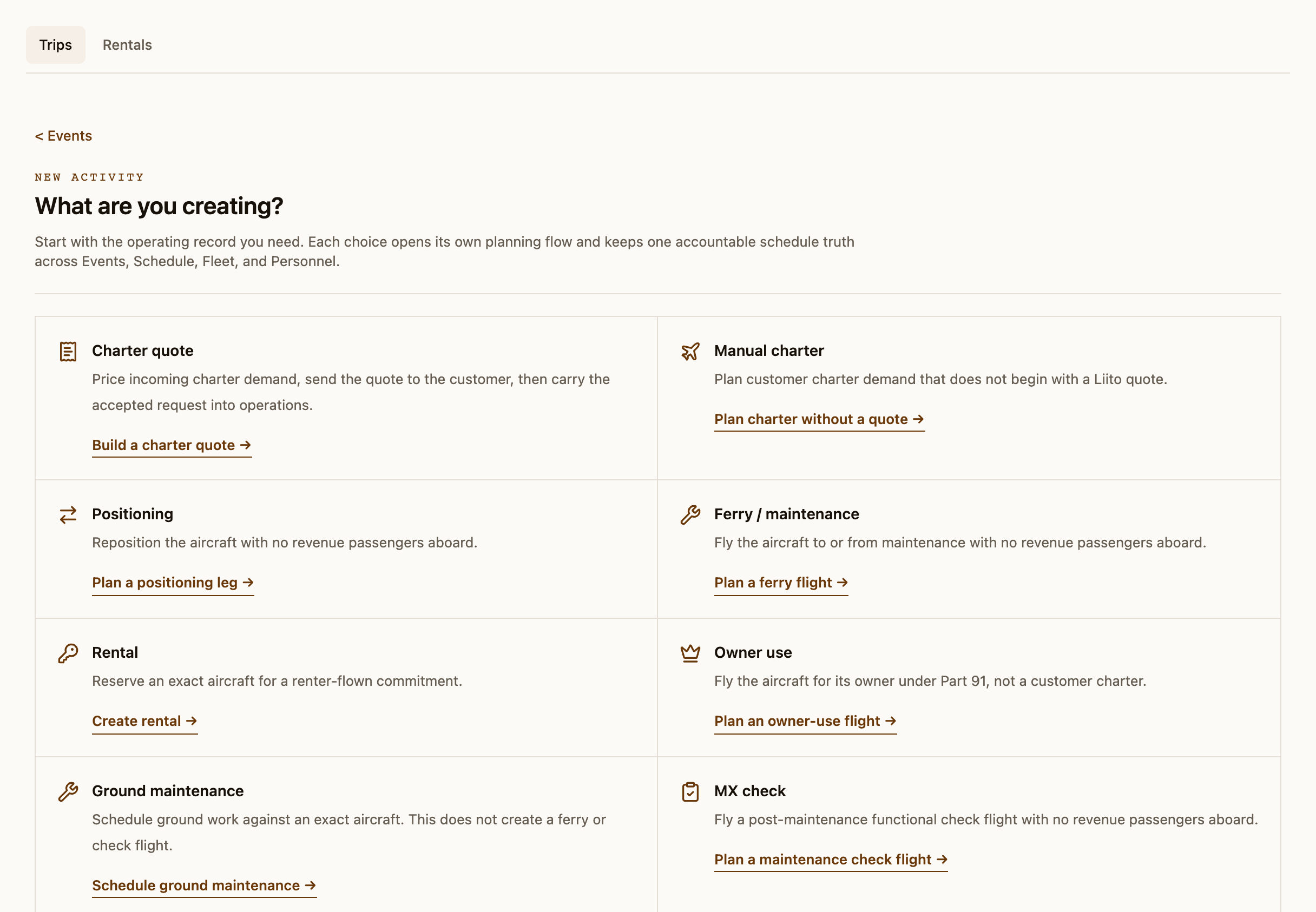
Starting new work in Liito: a screen asking what are you creating, with choices for a charter quote, a manual charter, positioning, ferry or maintenance, rental, owner use, ground maintenance, and a maintenance check flight.
New work starts by naming what it is. Every path lands on the same schedule.
6

Assemble it slot by slot New charter quote

A quote is built on the lines it will be dispatched from: who, when and where, passengers and services, then the aircraft and the price. The live quote prices as you compose, the lifecycle above it names each stage (request, quote, schedule, payment, release), and the next missing piece is always named.
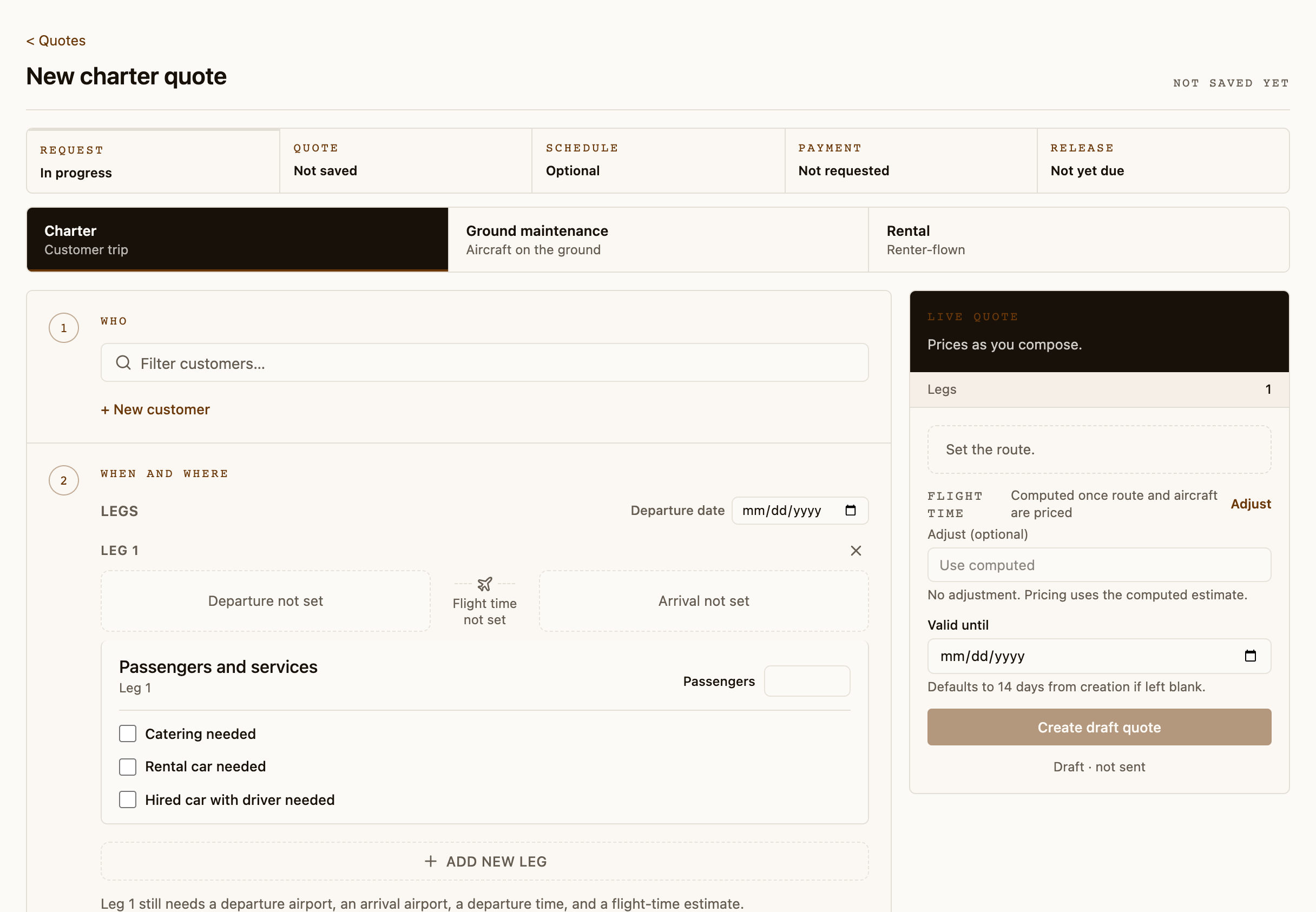
A new charter quote being composed in Liito: the lifecycle strip reading request in progress, quote not saved, schedule optional, payment not requested, release not yet due; steps for who and when and where; a live quote panel that prices as you compose.
A charter quote being born, already in the shape it will be dispatched in. The next move is always named.
When it matters

Caught on the ground, not on the ramp.

The release gate checks a flight against the conditions at its scheduled time, not the moment you happen to look. A medical that lapses before the trip, an inspection that comes due mid-week, a deferral that expires before departure: the gate flags it while there's still time to fix it on the ground, instead of discovering it on the ramp.

01 · As of the flight

Checked for the time it operates, not now

Every check projects to the leg's scheduled departure and arrival, not just today's status, so you catch a problem with time to act, not on the ramp.

02 · The checks, matched to the operation type

Every check named, matched to the operation type

Every release check is named in plain words, with what to do about it. A Part 91 or training leg runs the checks that apply to it. This is the regulatory and airworthiness release: weather, fuel, and airport judgment stay with the people who fly and dispatch, and their sign-off lands on the same record.

03 · The routing

Risk decides who signs, where §135 requires it

On a Part 135 flight the FRAT score sets approval routing: a routine flight clears through the normal path; an elevated score routes the sign-off to whoever holds the authority. On Part 91 and training legs the PIC's release is the authorization. The leg can't fly until the right person has signed.

04 · The record

Stated as the rule, traced to the cause

Each result states the rule behind it in plain words, points you to the exact thing that caused it, and says what to do; the manifest is verified and attested at release. The result is an audit-ready record of who cleared the flight and why, not a checklist someone ticked from memory.

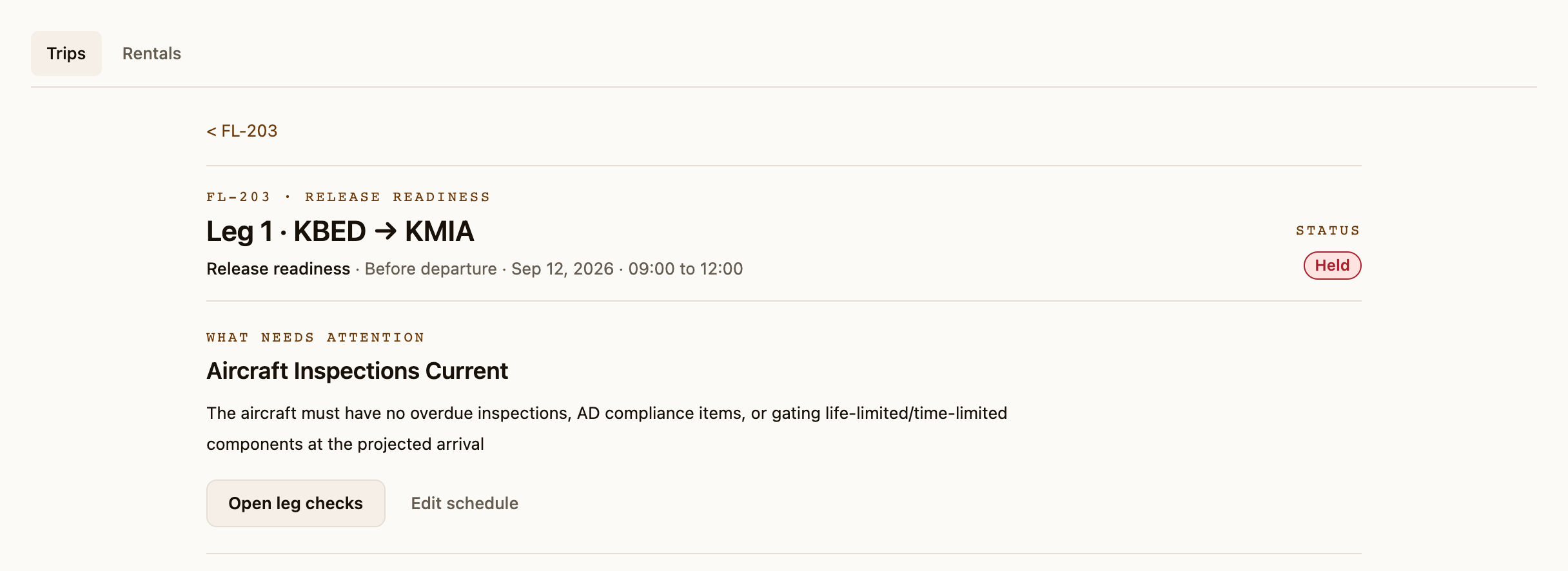
The release readiness page for one held leg: what needs attention reads aircraft inspections current, with the rule and the aircraft named, and the first of the passing checks beneath it.
One leg, held four days out: the failing check named, the rule behind it, and what to do.
● Pass ● Review · routes for sign-off ● Fail · release held The same gate runs under every operation type. Only the applicable checks change.
Even if it hasn't happened yetPatent pending

The airplane you'll have, not the one you have now.

Dispatch is a question about the future, not the present. Pick any moment on the schedule and Liito answers it for the whole fleet at once, because the same model that tracks an aircraft today can project it forward. Not a prediction: a projection.

Where will it be?

Pick any future moment on the schedule and every airplane shows where it will be and how Liito knows: at base, projected from the schedule, at its recorded arrival airport, in the shop, or out on a rental or a training flight. Ask once and you get the whole fleet, each position with its source named.

Will it be legal then?

The airworthiness gate doesn't ask "is it airworthy now." It asks "will it be airworthy when this leg lands." It adds up the hours scheduled between now and then. A 100-hour inspection comes due at 792.5 hours; the airplane sits at 787.5 with a training flight and this charter on the schedule, so it crosses the limit before this leg lands, and the flight cannot release. You see the conflict four days before dispatch, not after takeoff.

Projection updates itself: reschedule a flight, cancel one, record a meter reading, or close out a maintenance visit, and the fleet's projected readiness updates on the spot. The schedule moves; the answer moves with it.

One aircraft page in Liito with its projection clock: location as of a chosen moment with its source, the week's schedule for that tail, readiness for the next trip, and status for certificate, location source, home base, and inspection coming due.

A wrong release grounds an airplane. The forward-looking evaluation built to prevent that is patent pending.

In practice

Caught four days out, not on the ramp.

A charter for Ashcombe Group, KBED to KMIA, is accepted and paid. N803FL is assigned, the crew confirmed, the manifest verified. Commercially, it is ready to fly.

N803FL also has a 100-hour inspection due at 792.5 hours and sits at 787.5, with a training flight scheduled two days before the charter. Liito projects the meter through everything on the schedule to this leg's arrival, not just today's reading. The trip, the aircraft, and the release all show the same thing: the assigned tail will be overdue when the trip lands. Dispatch does not have to piece that together from three screens. It is one picture.

So the operator resolves it four days out: move the training flight, swap the tail, or bring the inspection forward, before a crew shows up to an airplane that cannot go. The conflict that would have shown up on the ramp gets handled from the desk.

The same charter seen from the trip page: accepted and paid, release blocked, next action reading that the inspection is projected to be overdue at arrival for the assigned aircraft.
One model underneath

Change one thing, and everything that depends on it already knows.

A rental hour moves a charter airplane's next inspection. An out-of-currency pilot holds a flight. That only happens because aircraft, maintenance, people, and money are one model, not four systems stitched together.

Aircraft & components

Set a model up once, then let each tail diverge. A fleet of identical airplanes still carries each one's own components, times, and history.

From meters to inspections to airworthiness

Airworthiness you can prove, because it's computed, not remembered. Hobbs and tach close out each flight and advance the inspections, the TBOs, and the ADs automatically.

People & currency

One record per pilot, and it follows them across charter, training, and rental. Currency runs on its own clock, and duty and rest clear against §135.267 before you ever assign a trip.

Money, quote to invoice

You bill what you flew, not what you quoted. A quote turns into a signed agreement and an invoice on its own, and the final number trues up to the meters when the flight closes.

Liito Labs

Aviation is where we started.

Liito Labs builds operations software for regulated industries, where the cost of a missed check is a grounded asset, a fine, or a shutdown. Liito, for aviation, is our first product, and our focus today.

Underneath it is Viiste, the machinery that makes a compliance guarantee cheap to build and defend: regulation modeled as forward-looking checks, every release evaluated against the time of the operation rather than the present, and an auditable account of every decision, each one tied to the rule behind it. We started in aviation because the rules are dense and the stakes are physical. Each industry we take on gets its own product, proven the same way.

How we build, and where the machine goes next, is on the investor page.

Liito Labs was founded by Aaron Elder, a pilot and airplane owner. Meet the founder.

What's next

Auditable by a person. Readable by software.

Liito is auditable because every decision is structured, recorded, and tied to the rule behind it. That same discipline is what makes the operation readable by software. Because the record is kept this clean, modern software can act on it directly, instead of guessing at it through a stack of exports and screens. The calls that must be made by the book are still made by the book. Everything around them is built to be read and acted on: by your dispatchers today, and by the software agents that will optimize operations in the background tomorrow.

Common questions

What operators ask before they switch.

Will it fit how I operate?

Yes. The rules flex to your ops spec, your authorizations, and your limitations. Liito fits your operation, not the other way around.

How hard is it to switch?

You don't switch all at once. Bring over the piece that hurts most, charter, training, or maintenance tracking, and add the rest when you're ready. Liito runs best when the whole operation is on it, and it earns that one piece at a time.

The demo list

See the whole day in one system.

Liito is in preview with a mixed-fleet operator, and not yet generally available. Demos open as availability does. Tell us a little about your operation and you'll be first in line for a walkthrough on a sample day: the dashboard, a flight going from held to released, the schedule with rentals and training in the mix, aircraft projection, planning the next trip, and the quote-to-invoice chain.

  • A real walkthrough with a person, not a canned video.
  • No sales spam. We use your note to prepare the session, nothing else.

We'll reply from a real address. Please don't include operationally sensitive or passenger data.

Request received.

Thanks, you're on the list. We'll reach out to set up your walkthrough as demos open.